Mental health practices across the USA are experiencing growing demand for services. While providers focus on helping patients improve their emotional well-being, the financial side of running a practice often becomes more challenging. Insurance rules, documentation requirements, coding updates, and claim denials can quickly affect cash flow if not managed properly.
This is where mental health medical billing plays a vital role. It helps mental health professionals receive timely reimbursements while reducing administrative stress and allowing them to spend more time with patients.
Whether you operate a private counseling practice, a behavioral health clinic, or a multi-provider organization, understanding the billing process can improve both financial performance and patient satisfaction.
Why Mental Health Billing Is Different
Mental health billing is more complex than billing for many other medical specialties. Providers must balance accurate documentation with patient privacy while following payer-specific guidelines.
Several factors make behavioral health billing unique:
Different therapy session lengths require different billing codes.
Insurance plans often have unique mental health coverage policies.
Prior authorization may be required for certain treatments.
Telehealth billing rules can vary by payer.
Documentation must support medical necessity without violating patient confidentiality.
Because of these factors, even small billing mistakes can delay payments or result in denied claims.
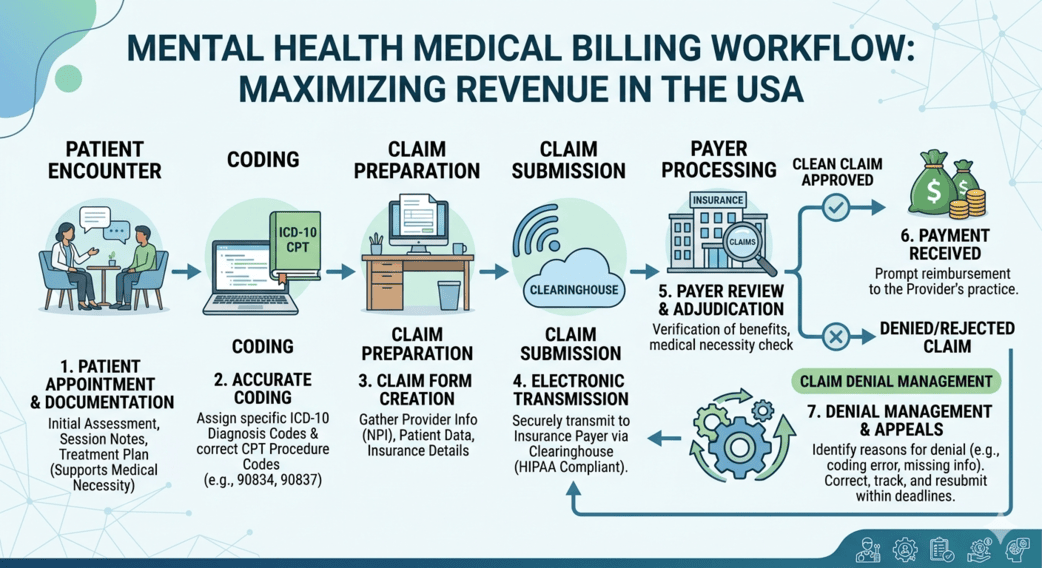
The Complete Mental Health Medical Billing Process
Successful billing follows a series of connected steps. Each one contributes to faster reimbursement and fewer billing errors.
Verify Insurance Benefits
Before the patient's appointment, practices should confirm:
Collecting complete demographic and insurance information is essential.
Missing details such as:
Incorrect member ID
Wrong date of birth
Expired insurance cards
can result in immediate claim rejection.
Clinical Documentation
Mental health providers must maintain clear documentation that supports the services performed.
Documentation generally includes:
Patient assessment
Diagnosis
Treatment goals
Therapy progress
Session duration
Clinical observations
Proper documentation protects both reimbursement and compliance.
Medical Coding
Assigning the correct diagnosis and procedure codes is one of the most important billing tasks.
Accurate medical coding services ensure that claims reflect the services actually provided while meeting payer guidelines.
Incorrect coding can lead to:
Claim denials
Payment reductions
Compliance risks
Insurance audits
Claim Submission
After coding is completed, claims are submitted electronically to insurance companies.
Modern claim submission systems often identify formatting errors before transmission, reducing the number of rejected claims.
Payment Posting
When insurance payments arrive, they must be matched correctly with patient accounts.
This step helps practices:
Track reimbursements
Identify underpayments
Monitor outstanding balances
Denial Management
Not every claim is paid on the first attempt.
Common reasons for denials include:
Incorrect coding
Missing documentation
Eligibility issues
Authorization problems
Filing deadline errors
Prompt denial analysis helps recover lost revenue more efficiently.
Common Billing Challenges for Mental Health Providers
Mental health practices often encounter several recurring billing obstacles.
Frequent Coding Changes
Insurance companies regularly update billing requirements. Staying current with coding changes requires continuous education and careful claim review.
Complex Insurance Policies
Different insurers may interpret mental health coverage differently, making claim submission more complicated.
Documentation Gaps
Incomplete documentation is one of the leading causes of denied claims. Providers should document each visit thoroughly while meeting compliance standards.
Telehealth Billing Rules
Virtual behavioral health visits have become increasingly common.
However, billing requirements may differ depending on:
Insurance company
State regulations
Place of service
Telehealth modifiers
Keeping up with these changes is essential for successful reimbursement.
Best Practices to Improve Mental Health Billing
Improving billing performance does not always require major operational changes. Consistent best practices often produce noticeable improvements.
Train Staff Regularly
Billing specialists should receive ongoing training on:
Insurance coverage may change between appointments.
Verifying eligibility before each visit minimizes claim denials caused by inactive coverage.
Monitor Key Performance Metrics
Practices should regularly review billing reports, including:
First-pass claim acceptance rate
Average reimbursement time
Denial rate
Accounts receivable aging
Collection percentage
These reports help identify areas needing improvement.
Maintain Strong Documentation
Providers should document services immediately after each session while information is fresh.
Clear documentation supports claim approval and simplifies audit preparation.
How Revenue Cycle Management Supports Mental Health Practices
An efficient revenue cycle management process connects every financial activity within a practice—from scheduling appointments to collecting final payments.
A well-managed revenue cycle can help practices:
Improve cash flow
Reduce billing delays
Lower denial rates
Increase reimbursement accuracy
Improve financial forecasting
Rather than focusing only on claim submission, revenue cycle management strengthens every stage of the reimbursement process.
Why Credentialing Matters
Many payment delays occur before the first patient is even seen.
Proper credentialing ensures providers are enrolled with insurance companies and eligible to receive reimbursement.
Without completed credentialing:
Claims may be denied.
Providers may not appear in insurance networks.
Payment delays can continue for months.
Keeping credentialing information updated is equally important when providers change locations, specialties, or insurance participation.
Should Practices Outsource Mental Health Billing?
Many behavioral health providers choose to outsource billing so they can focus on patient care.
Professional medical billing services often provide:
Certified billing specialists
Accurate coding support
Faster claim submission
Denial management
Compliance monitoring
Financial reporting
Outsourcing may also reduce administrative workload while improving reimbursement consistency.
Organizations such as 247 Medical Billing Services support healthcare providers with billing expertise across multiple specialties. While every practice has different operational needs, experienced billing teams can help simplify complex reimbursement processes without disrupting patient care.
Technology Is Changing Mental Health Billing
Healthcare technology continues to improve billing efficiency.
Modern billing platforms now offer features like:
Automated eligibility verification
Electronic claim submission
Real-time claim tracking
AI-assisted coding suggestions
Denial prediction tools
Performance dashboards
These tools help reduce manual work while improving billing accuracy.
However, technology works best when paired with knowledgeable billing professionals who understand payer requirements and compliance standards.
Final Thoughts
Mental health practices depend on accurate billing to remain financially stable while delivering high-quality patient care. Every step—from insurance verification and documentation to coding, claim submission, and denial management—contributes to successful reimbursement.
As payer requirements continue to evolve across the USA, maintaining efficient billing processes becomes increasingly important. Strong documentation, accurate coding, regular staff training, effective credentialing, dependable medical coding services, organized revenue cycle management, and experienced medical billing services all work together to support healthier financial outcomes.
By combining proven billing practices with the right expertise, mental health providers can spend less time managing paperwork and more time supporting the patients who rely on their care.
Frequently Asked Questions (FAQs)
1. What is mental health medical billing?
Mental health medical billing is the process of submitting insurance claims, applying diagnosis and procedure codes, tracking payments, and managing reimbursements for behavioral health services.
2. Why are mental health claims often denied?
Claims may be denied because of incorrect coding, incomplete documentation, insurance eligibility issues, missing prior authorization, or billing errors.
3. How does credentialing affect mental health billing?
Credentialing allows providers to participate in insurance networks. Without proper credentialing, insurance companies may reject or delay claim payments.
4. What is the role of medical coding in mental health billing?
Medical coding converts diagnoses and treatments into standardized codes used by insurance companies to process and reimburse claims accurately.
5. Can small mental health practices outsource billing?
Yes. Many independent therapists, counselors, psychologists, and behavioral health clinics outsource billing to improve claim accuracy, reduce administrative work, and speed up reimbursements.
6. How does revenue cycle management improve practice performance?
Revenue cycle management improves the financial health of a practice by reducing claim denials, improving payment timelines, monitoring collections, and strengthening overall billing efficiency.
7. How can practices reduce billing errors?
Practices can reduce errors by verifying insurance before appointments, maintaining accurate documentation, using updated coding guidelines, monitoring billing reports regularly, and working with experienced billing professionals when needed.




 French
