


Virtual Prototype Market to Grow at a CAGR of 19.4% Through 2034
Virtual Prototype Market Overview
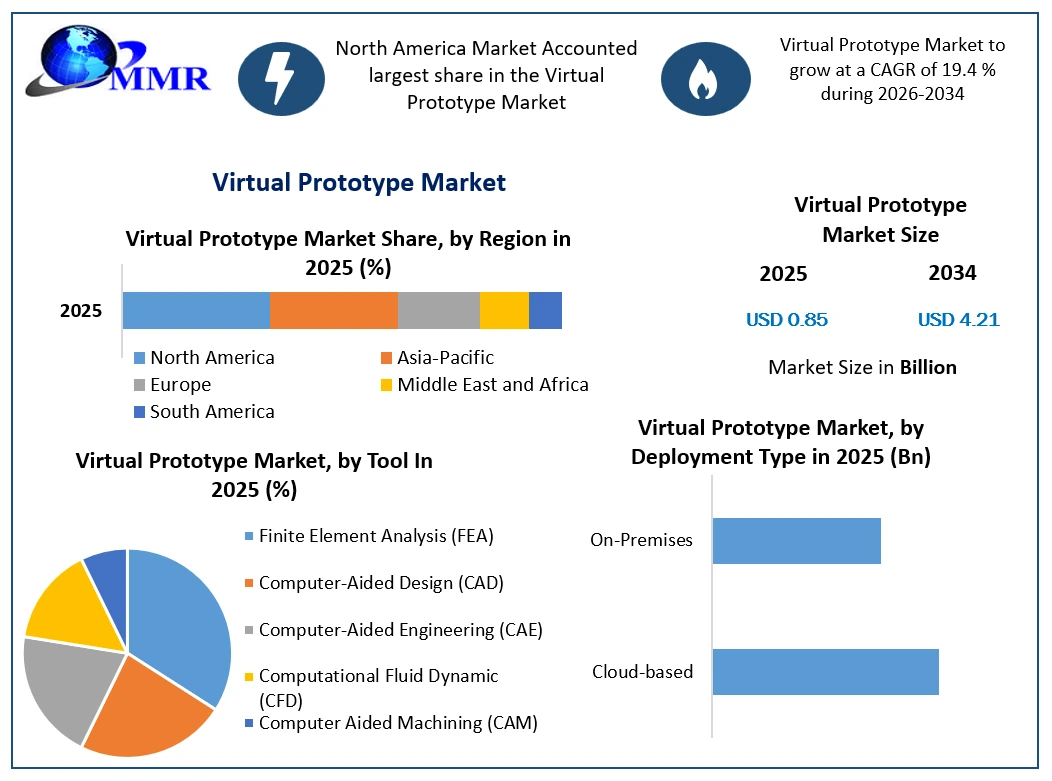
The global virtual prototype market is experiencing significant growth as industries increasingly adopt digital simulation, computer-aided design (CAD), and engineering software to improve product development. According to Maximize Market Research, the market was valued at USD 0.85 billion in 2025 and is projected to reach approximately USD 4.21 billion by 2034, growing at a CAGR of 19.4% during the forecast period 2026–2034.
Virtual prototyping is the process of creating a digital representation of a physical product, system, or component to evaluate its performance before manufacturing. It enables engineers and designers to simulate real-world conditions, identify design flaws, and optimize product functionality without relying entirely on physical prototypes. This approach helps businesses reduce development costs, improve product quality, and accelerate time to market.
The growing complexity of modern products across automotive, aerospace, electronics, healthcare, and manufacturing industries is increasing demand for virtual prototyping solutions. Companies are integrating advanced simulation tools into their product development workflows to improve accuracy, reduce production risks, and support faster innovation.
Request for a Free Sample of This Strategic Report ➤ https://www.maximizemarketresearch.com/request-sample/20906/
Virtual Prototype Market Growth Drivers
Increasing Demand for Cost-Effective Product Development
One of the primary factors driving the virtual prototype market is the need to reduce product development expenses. Traditional prototyping often requires multiple physical models, material consumption, labor, and repeated testing. Virtual prototyping allows companies to evaluate designs digitally before manufacturing, reducing the number of physical prototypes required.
Manufacturers can identify structural weaknesses, performance issues, and design inconsistencies at an early stage. This improves engineering efficiency and helps businesses manage development budgets more effectively.
Rising Adoption of CAD and Simulation Technologies
The growing use of computer-aided design and computer-aided engineering tools is supporting market expansion. CAD software enables engineers to create detailed digital product models, while simulation tools help assess mechanical performance, thermal behavior, fluid flow, and structural integrity.
These technologies are increasingly important in industries where product accuracy, reliability, and safety are essential. Continued improvements in simulation capabilities are encouraging businesses to incorporate virtual prototypes throughout the design and testing process.
Growing Integration of Digital Twin Technologies
Digital twin technology is creating additional opportunities for virtual prototyping. Digital twins use digital representations of physical assets and can incorporate real-time operational data to monitor performance and improve decision-making. When combined with virtual prototypes, these technologies support product development, testing, optimization, and lifecycle management.
The increasing adoption of Industry 4.0 practices is further encouraging manufacturers to use digital engineering tools to improve productivity and operational performance.
Virtual Prototype Market Trends
Artificial Intelligence and Machine Learning Integration
Artificial intelligence and machine learning are transforming virtual prototyping by improving simulation accuracy and automating repetitive engineering tasks. AI-powered tools can help engineers evaluate multiple design alternatives, predict product behavior, and identify potential failures. These capabilities support faster decision-making and more efficient product development.
Cloud-Based Virtual Prototyping
Cloud-based platforms are gaining attention because they provide flexible computing resources and support collaboration between geographically distributed engineering teams. Cloud deployment can reduce the need for expensive local computing infrastructure and enable smaller businesses to access advanced simulation tools.
Augmented Reality and Immersive Visualization
Augmented reality and advanced visualization technologies allow engineers to examine virtual models in realistic environments. These capabilities can improve design reviews, support collaborative product development, and help identify issues before production begins. The integration of immersive technologies is creating new opportunities for virtual prototyping providers.
Virtual Prototype Market Restraints and Challenges
High Initial Investment Costs
The implementation of virtual prototyping solutions can require significant investments in software licenses, computing infrastructure, system integration, and employee training. These expenses may limit adoption among small and medium-sized manufacturers with restricted budgets.
Shortage of Skilled Professionals
Virtual prototyping requires expertise in CAD, simulation, computational modeling, and engineering analysis. A shortage of trained professionals can slow implementation and reduce the effectiveness of advanced software solutions.
Data Security and Integration Issues
Virtual prototypes frequently involve confidential product designs, proprietary engineering information, and sensitive business data. Organizations must implement appropriate cybersecurity measures to protect intellectual property. Integrating new software with existing engineering systems and workflows can also create technical challenges.
Virtual Prototype Market Segmentation Analysis
The market is segmented by tool, deployment type, vertical, and region. These categories help identify the technologies and industries contributing to market demand.
By Tool
-
Computer-Aided Design (CAD): CAD held the leading position in 2025, supported by its use in digital modeling, visualization, design standardization, and product development.
-
Finite Element Analysis (FEA): Used to evaluate structural strength, stress, deformation, and mechanical performance.
-
Computer-Aided Engineering (CAE): Enables simulation and engineering analysis to optimize product designs.
-
Computational Fluid Dynamics (CFD): Helps analyze fluid flow, heat transfer, and aerodynamic performance.
-
Computer-Aided Machining (CAM): Supports manufacturing planning and the translation of digital designs into production processes.
By Deployment Type
-
On-Premises: This segment led the market in 2025 as organizations sought greater control over sensitive product designs, data, and engineering infrastructure.
-
Cloud-Based: Cloud solutions are gaining traction because they offer flexible computing capacity, lower infrastructure requirements, and easier collaboration between distributed teams.
By Vertical
-
Automotive: Virtual prototyping supports vehicle design, crash simulations, component testing, and electric vehicle development.
-
Aerospace: Engineers use virtual models to assess aircraft components, structural performance, and system reliability.
-
Electronics: Virtual prototyping enables early testing of electronic components, embedded systems, and semiconductor designs.
-
Healthcare: Digital modeling supports the design and evaluation of medical devices and selected healthcare technologies.
-
Petroleum and Chemical: Simulation tools help evaluate equipment, process designs, and operating conditions.
-
Government or Military: Virtual prototyping supports the development and evaluation of complex defense systems.
-
Telecommunications and Entertainment: Digital models help test system components and develop interactive virtual environments.
Regional Analysis of the Virtual Prototype Market
North America
North America held the largest regional market share in 2025, supported by early adoption of advanced engineering technologies, established software providers, and strong demand from automotive, aerospace, and electronics industries. Continued investments in digital engineering and simulation technologies are expected to support regional growth.
Europe
Europe represents an important market due to its established automotive and aerospace industries and its focus on manufacturing efficiency. The adoption of simulation-driven engineering is helping manufacturers improve product quality, reduce development costs, and accelerate innovation.
Asia Pacific
Asia Pacific is expected to offer significant growth opportunities, particularly as automotive, electronics, and aerospace industries expand in China and India. Increasing manufacturing activity and investments in digital transformation are encouraging businesses to adopt virtual prototyping technologies.
Middle East and Africa
The Middle East and Africa market is supported by industrial modernization, infrastructure development, and investments in advanced engineering solutions. Adoption opportunities are emerging across energy, manufacturing, aerospace, and defense applications.
South America
South America presents opportunities as manufacturers modernize production processes and seek more cost-effective approaches to product design and testing. Wider access to cloud-based engineering platforms could support adoption across the region.
Request for a Free Sample of This Strategic Report ➤ https://www.maximizemarketresearch.com/request-sample/20906/
Virtual Prototype Market Competitive Landscape
The virtual prototype market includes technology providers that compete through software innovation, simulation accuracy, product integration, cloud capabilities, and strategic partnerships. Companies are developing advanced solutions to help customers improve engineering productivity and reduce product development cycles.
Key companies operating in the market include:
-
NVIDIA Corporation
-
Cadence Design Systems
-
Autodesk
-
Synopsys
-
Siemens PLM Software
-
PTC
-
ESI Group
-
ARM Limited
-
Imperas Software
-
Qualcomm
These companies focus on strengthening their product portfolios through simulation software, digital engineering platforms, AI-driven capabilities, and tools for complex hardware and software development.
Recent Developments in the Virtual Prototype Market
The industry is seeing continued innovation in cloud-based engineering, AI-powered simulation, and virtual hardware development.
-
January 2025: Ansys showcased digital engineering solutions at CES 2025, including virtual prototyping workflows for vehicle crash safety, sensor validation, and functional safety.
-
February 2025: Altair introduced HyperWorks 2025 with enhanced cloud-native virtual prototyping workflows and AI-driven simulation capabilities.
-
March 2025: Synopsys announced the commercial availability of Virtualizer Native Execution on Arm-based hardware to support faster virtual prototype execution.
-
July 2025: Ansys released Ansys 2025 R2, featuring AI-powered simulation capabilities and automated workflows.
-
January 2026: Synopsys introduced a Virtualizer Development Kit supporting SOAFEE workflows for Arm Zena Compute Subsystems.
-
March 2026: Cadence Design Systems completed its acquisition of EMA Design Automation to expand its electronic system and PCB design capabilities.
Future Outlook for the Virtual Prototype Market
The virtual prototype market is expected to benefit from continued advances in AI, cloud computing, digital twins, and simulation technologies. As products become more complex and competition intensifies, manufacturers are likely to place greater emphasis on digital testing and early-stage design validation.
Automotive, aerospace, electronics, and industrial manufacturing companies are expected to remain important users of virtual prototyping solutions. Meanwhile, cloud platforms may improve accessibility for smaller businesses, while AI-assisted engineering could help reduce repetitive tasks and accelerate product optimization.
Despite challenges associated with implementation costs, cybersecurity, and skilled labor, continued technological innovation is expected to create opportunities for software developers, engineering service providers, and manufacturers.
Conclusion
The global Virtual Prototype Market is transforming product design and engineering by enabling organizations to test, validate, and optimize digital models before physical production. With the market projected to reach USD 4.21 billion by 2034 at a CAGR of 19.4%, demand is expected to increase as businesses prioritize cost efficiency, product quality, and faster development cycles.
About Maximize Market Research
Maximize Market Research Pvt. Ltd. (MMR) is a global market research and consulting company that provides reliable, data-focused, and practical business insights. The firm serves a wide range of industries, including healthcare, pharmaceuticals, technology, automotive, electronics, chemicals, personal care, and consumer goods. Through market forecasts, competitive analysis, strategic consulting, and industry impact assessments, MMR helps organizations understand changing market conditions, identify growth opportunities, and make informed business decisions for long-term success.
Contact US:
2nd Floor, Navale IT Park Phase 3
Pune Banglore Highway, Narhe
Pune, Maharashtra 411041, India
+91 9607365656
sales@maximizemarketresearch.com

 French