


Buying a home is exciting until someone hands you a loan estimate and your eyes glaze over at the numbers. You want one simple thing: to know what leaves your bank account every single month. Not a vague range. Not "it depends." An actual figure you can plan your life around.
If you are borrowing six figures and want the loan gone fast, the $100 000 mortgage payment 15 years question is the right one to be asking. A 15-year term is the shortcut to owning your home outright, and the monthly cost is far more manageable than most people assume. In this guide you will see the real numbers at real interest rates, what gets added on top, how much interest you save compared to a 30-year loan, and exactly how to check your own figure in seconds.
The Short Answer: What You Will Pay Each Month
On a $100,000 loan spread over 15 years, principal and interest usually land somewhere between $800 and $900 a month, depending on your rate.
Here is how it breaks down at common rates:
- At 5.5% you pay roughly $817 per month, with about $47,074 in total interest
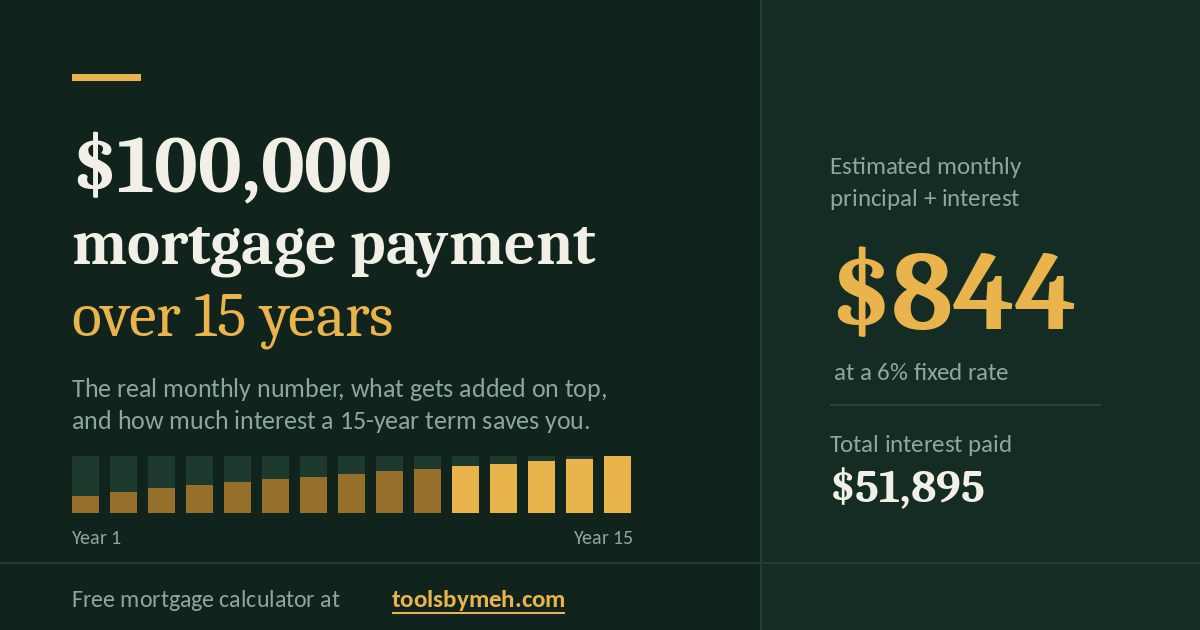
- At 6.0% you pay roughly $844 per month, with about $51,895 in total interest
- At 6.5% you pay roughly $871 per month, with about $56,800 in total interest
- At 7.0% you pay roughly $899 per month, with about $61,789 in total interest
Look closely at that list. A rate difference of just 1.5 percentage points changes your payment by only $82 a month, but it changes your lifetime interest by almost $15,000. That is the part lenders never put in bold on the brochure.
The Math Behind the Number
Your payment is calculated using a standard amortization formula. The lender takes your loan amount, your monthly interest rate, and the number of payments, which is 180 for a 15-year loan, and solves for the fixed amount that will wipe out the balance exactly on schedule.
What makes this interesting is how the split shifts over time. In month one at 6%, about $500 of your payment goes to interest and roughly $344 goes to principal. By year ten, that flips hard, and the majority of every payment is attacking the balance itself. By the final year, almost the entire payment is principal.
This is why the 15-year loan feels slow at first and then feels unstoppable. Equity builds quietly in the early years and then snowballs.
15 Years vs 30 Years: The Comparison That Actually Matters
This is where most buyers make a decision worth tens of thousands of dollars without running the numbers.
Take the same $100,000 at 6%:
- 15-year loan: about $844 per month, roughly $51,895 paid in interest
- 30-year loan: about $600 per month, roughly $115,838 paid in interest
The 30-year option saves you around $244 every month. That feels good. But it costs you nearly $64,000 more over the life of the loan, and it keeps a mortgage on your back for an extra fifteen years.
When people run the $100 000 mortgage payment 15 years numbers for the first time, this is usually the moment the decision makes itself. You are not paying an extra $244 a month for nothing. You are buying back fifteen years of financial freedom and cutting your interest bill roughly in half.
There is a second bonus most buyers miss. Lenders typically price 15-year loans at a lower interest rate than 30-year loans, often by a quarter point to a full point. So the gap between the two payments is usually even smaller in real life than the example above suggests.
What Actually Shows Up on Your Monthly Bill
The $844 figure is principal and interest only. Your real housing payment includes more, and this is where budgets quietly break.
Expect these additions:
- Property taxes. Commonly 0.5% to 2.5% of home value per year, collected monthly into escrow
- Homeowners insurance. Usually $80 to $200 a month depending on location and coverage
- Private mortgage insurance. Applies if your down payment is under 20%, typically 0.3% to 1.5% of the loan annually
- HOA dues. Anywhere from $0 to several hundred a month in condo or planned communities
- Flood or hazard coverage. Required in certain zones and not optional once mandated
A payment that looks like $844 on paper can realistically sit between $1,100 and $1,400 once everything is stacked on. Budget for the full picture, not the headline number.
How Much Income Do You Need?
Most lenders want your total housing payment to stay at or below 28% of gross monthly income, and your total debt payments at or below 36% to 43%.
Using a full payment of around $1,150 including taxes and insurance, you would want gross monthly income near $4,100, which works out to roughly $49,000 a year. If you carry a car loan or student debt, aim higher so the debt-to-income ratio stays comfortable.
Strong credit helps enormously here. Moving from a 680 score to a 760 score can shave a meaningful chunk off your rate, and on a 15-year term that translates directly into thousands saved.
Smart Ways to Lower What You Pay
You have more control over this number than you think. Try these before you sign anything:
- Shop at least three lenders. Rate quotes on identical profiles routinely vary by half a point or more
- Increase your down payment past 20% to eliminate mortgage insurance entirely
- Buy discount points if you plan to stay long term, since each point typically cuts the rate by around 0.25%
- Clean up your credit report ninety days before applying, disputing errors and paying down card balances
- Ask about lender credits that trade a slightly higher rate for lower closing costs if cash is tight today
- Lock your rate once you find a good one instead of gambling on the market moving your way
Who Should Choose a 15-Year Term
A 15-year mortgage is an outstanding fit if you have stable income, a healthy emergency fund, and you want to be debt free before retirement or before tuition bills arrive. It also suits refinancers who have already paid down a chunk of a 30-year loan and want to finish strong.
It is a poor fit if the higher payment would leave you with no savings cushion, if your income is irregular, or if you are prioritizing retirement contributions that carry an employer match. In those cases a 30-year loan with voluntary extra principal payments gives you the same speed with an escape hatch built in.
Running your own $100 000 mortgage payment 15 years scenario side by side with a 30-year version is the fastest way to see which one your budget actually supports.
Conclusion
You now know the number, the math behind it, and the extras that ride along with it. A $100,000 loan over 15 years lands near $800 to $900 a month in principal and interest, builds equity fast, and can cut your lifetime interest roughly in half compared to stretching the same loan over three decades.
But your situation is not a textbook example. Your rate, your taxes, your insurance, and your down payment all move the final figure. Guessing is expensive, and rounded estimates from a blog post will never match what appears on your closing disclosure.
Get your precise number in under a minute. Head over to ToolsByMeh and use the free mortgage calculator to plug in your exact loan amount, rate, and term. Compare 15-year and 30-year side by side, add taxes and insurance, and see the full amortization breakdown instantly. No signup, no email, no cost. Walk into your lender meeting already knowing what the numbers should say, and negotiate from a position of strength.
Frequently Asked Questions
What is the monthly payment on a $100,000 mortgage over 15 years?
At a 6% interest rate, the principal and interest payment is approximately $844 per month. At 5.5% it drops to around $817, and at 7% it rises to about $899. Property taxes, homeowners insurance, and mortgage insurance are added on top of this figure.
How much total interest will I pay on a 15-year $100,000 loan?
Roughly $51,895 at a 6% rate across the full 180 payments. Lower rates reduce this significantly, with 5.5% bringing it down to about $47,074.
Is a 15-year mortgage better than a 30-year mortgage?
It depends on your cash flow. The 15-year option saves tens of thousands in interest and clears the debt in half the time, but the monthly payment is higher. If the larger payment strains your budget, a 30-year loan with extra principal payments offers similar benefits with more flexibility.
What credit score do I need for the best 15-year rate?
Most lenders reserve their strongest pricing for scores of 740 and above. Scores in the 620 to 700 range typically still qualify but carry higher rates, which meaningfully increases both your monthly payment and total interest.
Can I pay off a 15-year mortgage early?
Yes. Most conventional loans have no prepayment penalty, so extra principal payments go straight toward the balance and shorten your term further. Always confirm the terms with your lender before making large additional payments.
Do I need 20% down for a 15-year loan?
No, but putting down less than 20% usually triggers private mortgage insurance, which adds to your monthly cost until you build sufficient equity.

 French
